Taiwan
Loveboat, TaipeiTaiwan is the setting through which Ever Wong’s summer becomes more than an excursion into her parents’ heritage: it is a place she comes to experience, question, and finally love on her own terms. From the rain-beaten lobby of Chien Tan to the flooded villages of the south, the island is both an intimate social world and a landscape marked by forces larger than the travelers passing through it. Ever leaves with a new appreciation of her parents’ bilingual lives and a changed sense of belonging; she does not mistake that connection for effortless cultural fluency or a need to disappear into the crowd.
Setting and First Encounters
A typhoon to the north of Taipei sends showers across the city as Ever returns to the dorms at Chien Tan on a Thursday evening. Wind pushes her through the lobby doors and tugs at a bag of paper lanterns she has bought for Sophie’s weekend gathering. Inside, students play Go and mah-jong while Mei-Hwa tries to recruit listeners to her collection of Taiwanese Aboriginal pop. Her music and animated gestures make the lobby a place of exchange: Taiwan is not presented to Ever only as a destination to look at, but as a culture her companions inhabit and share.
Ever’s own family history complicates the easy assumption that the students’ heritage is hers in the same way. When Aunty Claire asks whether her parents have lived in Taiwan long, Ever explains that they are not from Taiwan: they migrated from Fujian to Singapore and then to the United States. The answer draws the family’s attention to her, and Aunty Claire responds by emphasizing shared humanity and praising the bravery and intelligence of immigrant parents. Ever’s explanation establishes a distinction between ancestry and personal experience: her parents’ migration is part of her history, but it does not make Taiwan her family’s place of origin.
Taipei and the Museum Landscape
The National Palace Museum visit offers a formal view of the island’s cultural setting. On a Friday afternoon, the group arrives in warm rain at a gate with five white arches and sea-green roofs. Ever and Laura struggle along the flagstone avenue under their umbrellas; thick-leaved trees frame a sprawling beige palace at the base of a mountain, with five matching sea-green-and-orange pagodas rising at its center and on either side. The rain shapes the visit physically, while the scale and arrangement of the museum complex place the travelers inside a designed landscape rather than an abstract idea of Chinese heritage.
The excursion is also threaded with the group’s unruly social life. Halfway to the museum, they come upon Sam and David on their hands and knees, soaked through, while Peter and Marc climb onto them to make a human pyramid for a phone photograph. Ever asks what they are doing and chooses to act as though she does not remember that David had one of her nude pictures. The encounter brings the consequences of the leak into the setting without turning the museum visit into a separate, insulated cultural lesson: sightseeing, embarrassment, friendship, and unresolved harm travel together.
The Island Tour and Typhoon Flooding
During the Tour Down South, Taiwan becomes a route experienced from the back of a bus and then on foot. Ever and Rick share a seat on Bus A, one of eleven luxury buses carrying the Chien Tan group around the island. Their caravan passes along highways raised on concrete stilts, above leafy treetops; city skylines with modern buildings and swallowtail roofs give way to farmland, glass-roofed greenhouses, concrete dikes, waterways, and mountains densely covered in green. This changing sequence makes the island legible through contrast: urban construction, cultivation, flood-control infrastructure, and mountainous terrain appear as parts of a continuous journey.
At Taroko Gorge, the bus leaves the travelers between cliffs covered in emerald moss. A river cuts through them in shifting shades of blue, and Ever and Rick race ahead over the rocks. The pace of the trip briefly gives way to direct physical encounter: the landscape is not just scenery beyond the bus windows but ground under Ever’s feet, something she can move through and marvel at as real.
As the typhoons intensify, however, the tour’s scenic passage also reveals the disaster’s human cost. Rain sheets against the bus windows and blurs the countryside; the travelers pass a Puyuma village submerged under muddy water, with only tin-roof peaks above the surface. Debris includes an overturned rickshaw wheel, dead fish, and a muddy doll in a red-, yellow-, and green-striped skirt. Debra asks whether anyone was hurt, and the tour guide says no, after which conversation resumes. The brief exchange sits uneasily beside the visible wreckage: reassurance allows the bus’s social rhythm to continue, but does not erase the devastation the passengers have witnessed.
Love, Travel, and a Changing Sense of Place
Rick’s letter alters the terms of Ever’s relationship with him during the tour. He writes that he felt recognition when they first met, admires her courage and kindness, and finds that dancing with her brings him into balance. He says he will wait rather than try to persuade her into a decision. After reading the letter, Ever searches online for how to know when someone is falling in love. The ensuing journey places that still-unresolved feeling amid the worsening typhoon: the trip continues, but the natural world pressing against the bus windows gives the landscape an urgency that contrasts with the private delicacy of Rick’s promise.
On the tour’s last full day, the group arrives at the hot springs resort Sophie has praised throughout the summer. Ever and Rick walk hand in hand through floodwater ankle-deep on a stone path, past dripping palms and through bamboo toward the resort; Lán Huā Cǎo plays from hidden speakers. They have been holding hands since Rick’s letter, though they have not kissed again. The rain and water make the approach both romantic and precarious, while their restrained closeness keeps the relationship’s next step open. Taiwan’s weather is not merely a backdrop for the romance: floodwater is literally underfoot as the two move together.
Departure and Cultural Belonging
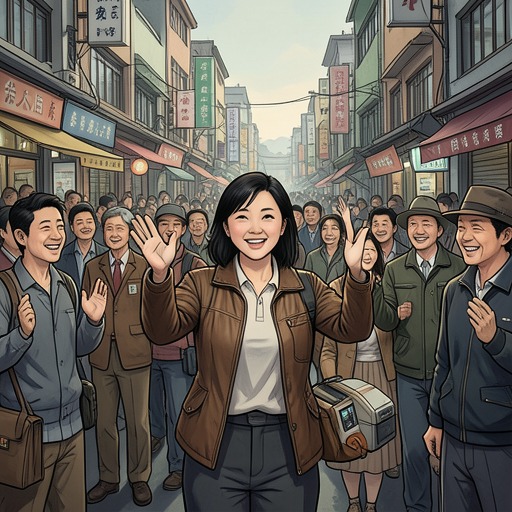
At Taoyuan International Airport, the crowd of thousands no longer feels frightening to Ever. She recognizes that there are things she will not miss about Taipei, including its many mopeds and oppressive humidity, but says she has grown to love its people, night markets, and ubiquitous street food. Her attachment is specific and mixed rather than idealized. She also expects to miss the intensity of her Loveboat friendships and is grateful that those relationships will continue beyond the summer.
Ever’s final reflection connects that affection to the experience of being visible and of blending in. She will miss the anonymity of blending into Taiwan’s crowd, but allows that perhaps she was never meant to blend in. The thought does not cancel the comfort she found there; it distinguishes belonging from disappearance. Her response to Mandarin likewise registers change without pretending mastery: she can read only a few dozen characters, yet signs, newspapers, and magazines no longer seem like random symbols. She can recognize meaning in the characters she knows and in the images their components evoke—doors, eyes, hands, water, hearts, rain, trees, suns and moons, fire, power, and other forms. For now, that partial recognition is enough. Taiwan has become meaningful to her not because every cultural boundary has vanished, but because she has learned to see connection where she once saw unreadable signs.